Auvra Joins NVIDIA Inception Program to Accelerate AI for Cultural Preservation
Auvra has been accepted into the NVIDIA Inception Program, speeding up Lens AI for transcribing and translating African oral histories.
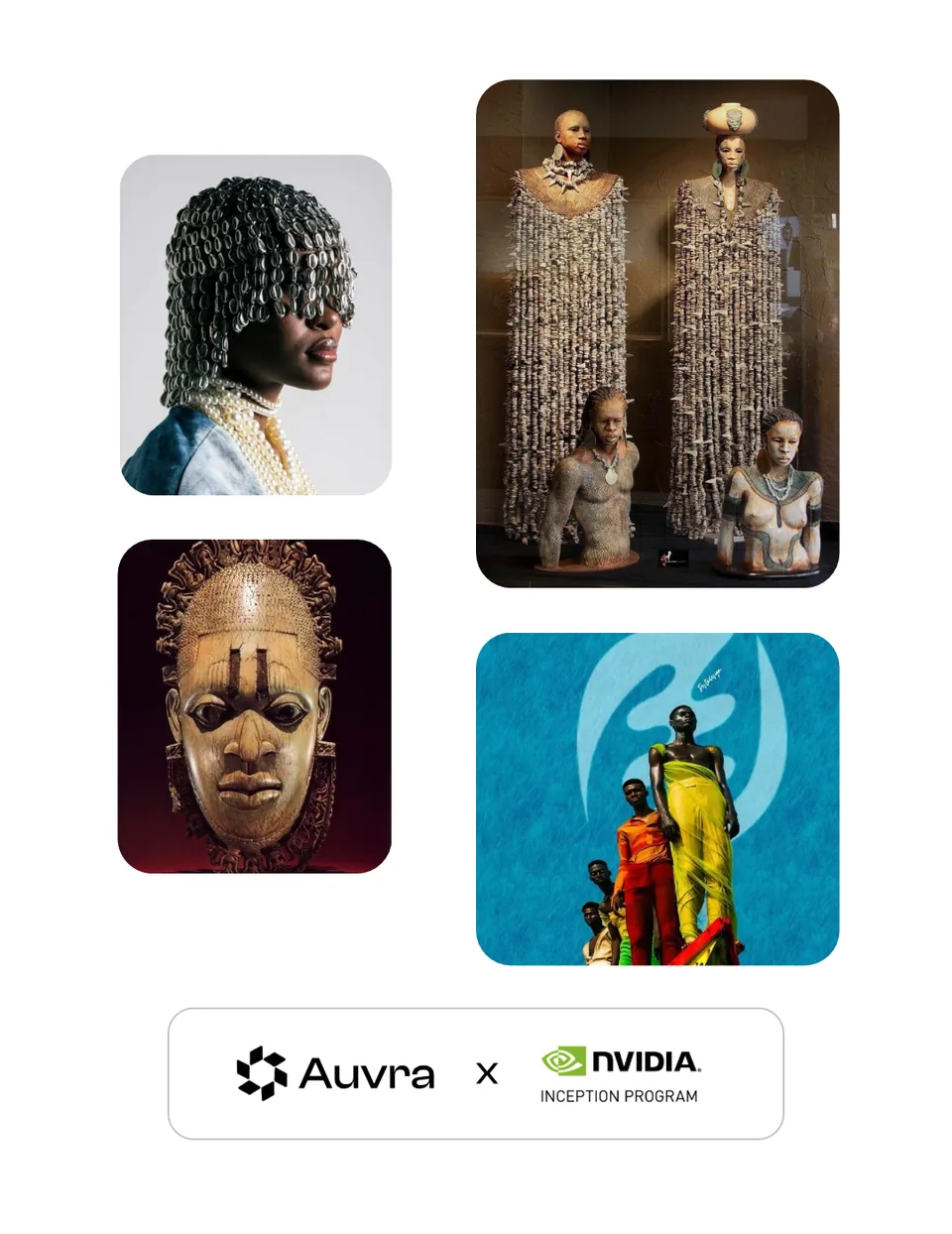
The world’s leading AI hardware company is now backing cultural infrastructure. This week, Auvra was officially accepted into the NVIDIA Inception Program, a global initiative that supports cutting edge AI startups with technical resources, mentorship, and go to market support.
NVIDIA Inception provides qualifying startups with access to GPU credits, preferred access to hardware and software, deep learning training, and introductions to a worldwide network of investors and technology partners. For Auvra, this means faster development of Lens AI, our custom model for transcribing and translating African oral histories, and the ability to scale our cultural preservation infrastructure across more languages, communities, and institutions.
Why This Matters
Most AI models are trained on dominant languages such as English, French, Mandarin, and Spanish. African languages remain severely underrepresented. Lens AI is built to close that gap, fine tuned for low resource African languages, oral storytelling patterns, and cultural contexts that generic models routinely miss.
Through NVIDIA Inception, Auvra gains GPU credits and preferred access to NVIDIA hardware and software, reducing the cost of training and deploying AI models. We also receive technical mentorship from NVIDIA engineers, helping us optimize Lens AI for real world performance. We get exposure to NVIDIA’s global VC network via Inception Capital Connect, which opens doors to investors who understand the scale of AI driven preservation. And for selected members, the NVIDIA Innovation Lab offers two months of hands on access to NVIDIA DGX Cloud, integrated AI software, and expert support.
A Story from the Field
A few weeks ago, Emmanuel John, founder of Auvra, was speaking with a community elder in Delta State. She is 82 years old. She speaks a dialect that only a handful of people in the world still understand. Her children speak English and Pidgin. Her grandchildren do not understand her at all.
She wanted to record a story. A story her grandmother told her. A story about a war, a migration, a river that changed course. It took her fifteen minutes to tell it. Her voice cracked in the middle. She laughed at the end.
That recording is now preserved on Auvra. But transcribing it? Translating it? That took days. Because the AI model we were using did not understand her dialect. It was not built for her voice.
That is what NVIDIA changes.
With access to NVIDIA’s infrastructure, we can train Lens AI to understand her the first time. Not after months of fine tuning. Not after costly rounds of compute. Her voice will be part of the model from the beginning.
That is not just faster technology. That is dignity.
What This Means for Lens AI
Lens AI is not a wrapper around existing models. It is being fine tuned from the ground up for African languages, oral traditions, and the specific acoustic environments of field recorded histories. With access to NVIDIA’s advanced AI infrastructure, we can train models faster, cutting development cycles from months to weeks. We can improve transcription accuracy for low resource languages that global models ignore. We can run real time inference in low connectivity environments, critical for rural communities where elders hold irreplaceable knowledge. And we can scale the Auvra Registry, our public infrastructure for verifiable cultural records, to handle a fast-growing archive of preserved records.
“Our entire platform runs on GPU accelerated AI,” said Emmanuel John, founder of Auvra. “From transcribing oral histories to verifying provenance, every part of Auvra depends on reliable, fast, and culturally aware AI. NVIDIA Inception gives us the tools to build that at scale.”
What Comes Next
In the immediate term, Auvra’s engineering team will use NVIDIA’s resources to accelerate Lens AI training for four initial African languages: Yoruba, Igbo, Hausa, and Swahili. We will optimize models for offline deployment, ensuring that oral histories can be transcribed even when internet connectivity is unavailable. We will scale the Auvra Registry to handle high volume queries from researchers, institutions, and diaspora communities. And we will apply for the NVIDIA Innovation Lab to speed up Lens AI training even further.
In the long term, this partnership signals something bigger. NVIDIA is backing African AI as a priority, not an afterthought. The same company that powers autonomous vehicles and climate research is now powering the preservation of Ijaw proverbs, Yoruba oriki, Awka blacksmithing techniques, and countless other traditions.
The Takeaway
NVIDIA did not just accept a startup. They accepted a mission.
Auvra is now part of the world’s most advanced AI ecosystem. That means faster development. Smarter infrastructure. Stronger technology for everyone preserving culture.
NVIDIA bet on Auvra. Now we prove them right.